Tag Archives: lunch

Beef Kidney Stew 2 Different Ways–Red or White

Standard

Red Kidney Stew

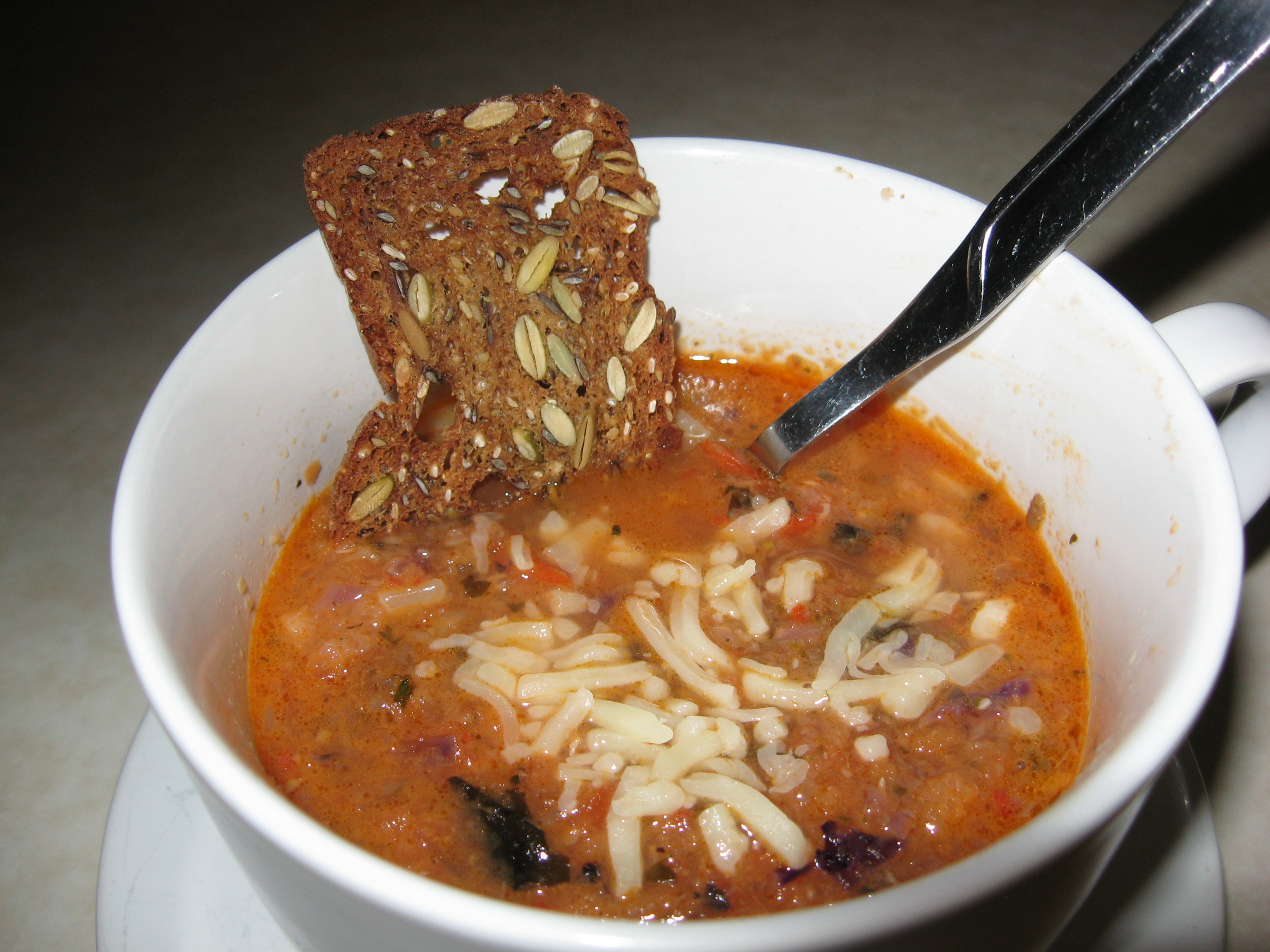
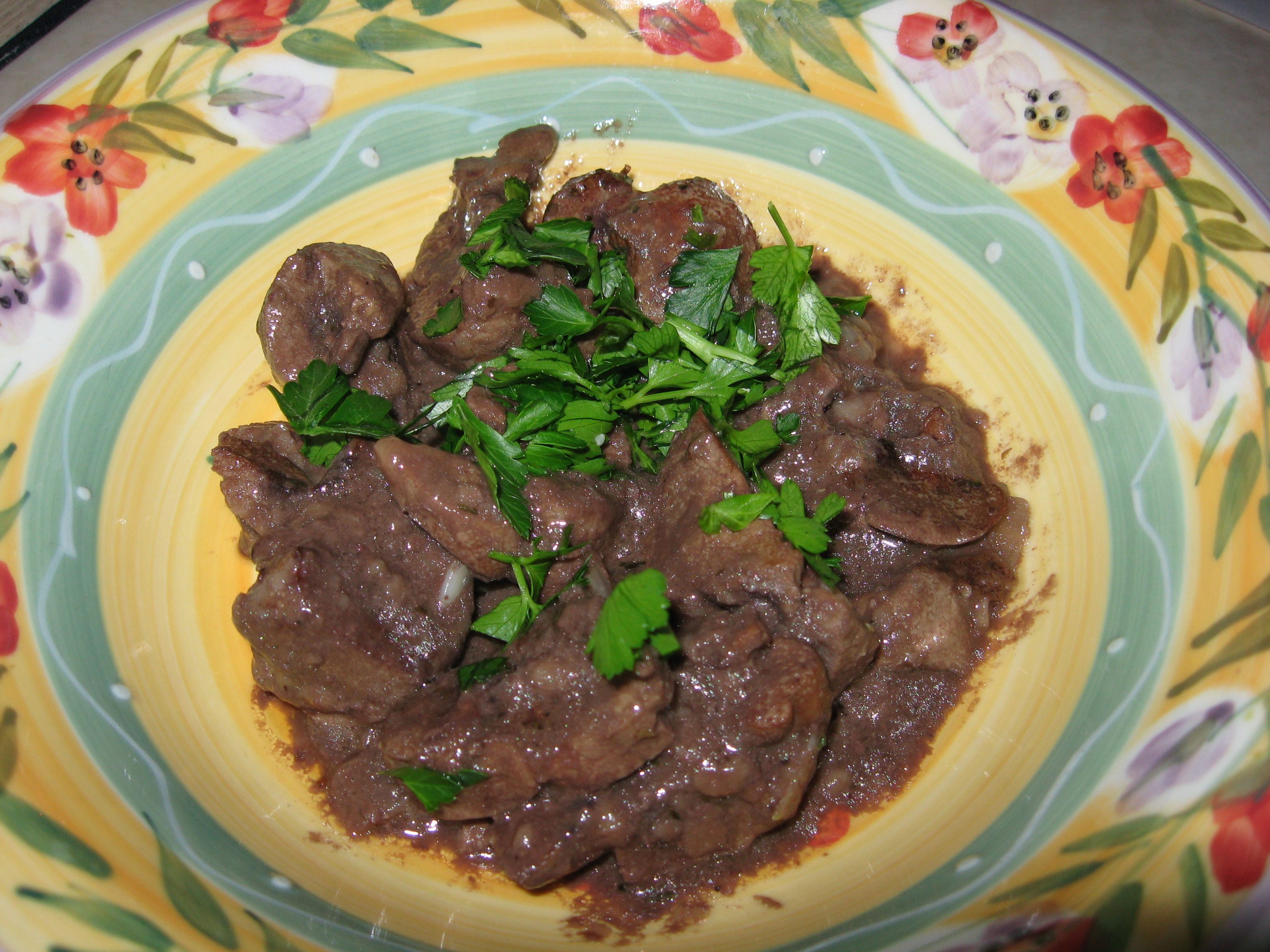
Beef Kidney Stew 2 different ways—either red or white ( red style in picture)

Serving 2 to 4 people


Listening to NPR today, 3/5/13, the Dow hit a firm over the 14,000 mark and supposedly the economy is healing.  For myself, I am still looking closely at my grocery prices and honestly, I can’t think of anything that I have bought lately that can beat this: one beautiful large grass fed USDA organic beef kidney at the Ketchum Atkinsons’ for under $1.  It can easily feed two and maybe even four depending with what you are serving it.  I served it with a Provence Potato Gratin, (recipe coming in another column) a lovely salad and some nice veggies. Noodles, boiled potatoes or rice also is good served with the kidneys. You can even do an English thing: serve the kidneys on toast for breakfast.


Now you may turn your nose up at organ meat, but aside from it being high in cholesterol, it is very delicious if you fix it properly.  I think most people just get turned off at the “organ” connection here in the United States: not in Europe. The important thing with kidneys is not to cook them too long—or they’ll become tough. The texture is NOT slimy and has in fact a great texture to it.  The taste I think is magnificent.  Give it a try and you’ll see——-


The basic prepping of the kidney:

  1. Cut away the white membrane of the kidney with curved scissors or a sharp small knife. Patience is required for this process—but it’s worth it.
  2. Place the kidney in a bowl and add water mixed with 3 Tblsp. wine vinegar to barely cover it.
  3. Let it sit for 2 hours. (Patience again please)
  4. Drain the kidney and wipe it dry.
  5. Cut it in thin slices and sprinkle with salt and pepper and dredge with flour for the “Red Way” but not necessarily for the “White Way” and if you decide to dredge for the “White Way” increase the butter and olive oil to the same amounts as in the “Red Way”. And by the way, if you wish to use Sherry instead of the red or white wines, give it a go.


Kidney Stew—the “Red Way”:

Ingredients:

  1. 1/4 C. butter
  2. 3 Tblsp. olive oil
  3. 1 clove garlic,  finely chopped
  4. 1/2 C. onion, chopped
  5. 1/2 Tsp. dried rosemary (you can use 1 Tsp. fresh as well)
  6. 1/2 Tsp. dried thyme (you can use 1 Tsp. fresh as well)
  7. 1 Bay leaf
  8. 1/2 C. dry red wine
  9. 1/2 C. beef broth

Instructions:

  1. In a large skillet, heat the olive oil and butter and when bubbling, QUICKLY brown the kidney slices on both sides.
  2. Add the garlic, onion and herbs and cook 5 minutes (not longer).
  3. Add the wine and broth and simmer at the most, 15 minutes more.
  4. Serve with what I suggested in my introduction.
  5. PS-Don’t tell the kids what they are eating and I bet that you’ll be in for a surprise.


Kidney Stew—the “White Way:

Ingredients:

  1.  3 Tblsp. olive oil
  2. 2 Tblsp. butter
  3. 2 Tblsp. chopped parsley
  4. 1 Tblsp. chopped shallots or chives
  5. 3 Tblsp. flour
  6. 1 ½ C. dry white wine or vermouth
  7. 1/2 C. water
  8. 2 Tsp. butter
  9. 2 Tsp. butter
  10. S&P to taste

Instructions:

  1. Heat the oil and butter in a skillet; add the kidneys and brown QUICKLY on all sides.
  2. Reduce the heat and add the parsley and shallots.  Cook 3 minutes stirring occasionally. Remove the kidneys to another dish and cover it to keep warm.
  3. If you have not floured your kidneys, now place the 3 Tblsp. flour into the pan juices and add the wine and water.  Stir until smooth.
  4. Remove from the heat and add the 2 Tsp. of butter.
  5. Season with lemon juice, S&P and pour sauce over the kidneys.


Artichokes Spells Green Goodie for St. Pat’s

Standard


Frost Kissed Artichokes are in town—just in time to celebrate the GREEN of St. Pats (PART ONE)

This is the first of a two series presentation of Artichoke Recipes—so stay tuned!!


I do really enjoy artichokes and have had a lot of fun with new comers in the instruction of the “how to eat” an artichoke.  When I resided in CA I used to grow these edible thistles in my yard so I garnered very fresh chokes that barely needed to be cooked.  Here our chokes are usually a bit older however the ones I picked up the other day at the Bellevue Atkinsons’ for such a good price were the frost kissed variety so I knew that they weren’t very old. Sure enough, when cooking them I started smelling their fragrant aroma in 20 minutes and 5 minutes later, they were done and delicious. Frost Kissing occurs when the temps drop below 32 degrees resulting in an enhanced nutty flavored artichoke. So if you like this veggie, hurry and get some.  They also make great appetizers.


There are a myriad of ways to which to treat this thistle in a culinary fashion.  I’ve even been given a recipe dealing with using raw artichoke strips in a salad.  Sad to say, I was very disappointed with that recipe. Below is the way I’ve always cooked my choke plus another easy greener recipe I thought you might enjoy.  Next week will be another very tasty recipe that my editor, Leslie Thompson, a terrific cook, is offering for the followers of this column.   


Basic Instruction for Prepping an Artichoke:

Hold the choke by its long end and with a scissor, cut the individual leaf ends off so that the thorns are removed; next, with a serrated knife, cut both ends of the choke: the stem close to the choke bottom and the very top off about 1/2 inch.  Now wash them and they are ready to be cooked.

Margot’s Favorite Way:

Cooking instructions:

Place the chokes in a tall pot that accommodates your chokes and fill the pot with water (I put in warm or hot water) that goes about half way up. In the water add a dash of olive oil,  one or two bay leaves, one or two whole peeled or even unpeeled garlic cloves, some pepper corns and a dash of sea salt and a squirt of your favorite vinegar or lemon juice.  You can also add some fresh tarragon or thyme.  Put the pot on the burner and when the water comes to a boil, turn it down to a rolling simmer and place a top that will fit in and not on top of the pot. This will keep the chokes under the liquid and from discoloring. If you don’t have that size top, just put a regular top on the pot. Start testing in 25 minutes by trying to take a leaf off with ease to see if it is tender. I use tongs to do that. Also I’ve noticed that when the choke starts smelling good, that’s when you know that it’s about done.  An artichoke can be done in as little as 20 minutes or as long as a bit over an hour—depending on size and age.  When done, turn the choke upside down in a bowl to drain. If you have left over’s, they can be stored in the frig for several days and reheated in the micro or just enjoyed cold or stuffed for hors d’oeuvres. Oh my, so many options with a choke—————–

I like to eat my chokes plain but many people like to dip the leaves in melted butter, olive oil or mayonnaise.  You can even combine the butter or olive oil you are using as a dipping sauce with a dash of minced garlic, lemon juice and S&P or/and some grated Parmesan or some dill or Dijon mustard.  And if serving the choke cold as an hors d’oeuvre, mayo with a dash of curry or other powder is a breeze to whip up. Well, you get the idea—- imagination is the ingredient here.

Lastly, no matter how you cook and eat your choke, don’t forget to remove the uneatable furry/fuzzy part to get to the best part—the heart. Also remember to provide an empty bowl on the side of the artichoke for discarded leaves and when guests are present, I usually put one discarded leaf in the bowl as an example.

Thinking of St. Pats, here’s an extra green to stuff in your choke:

  1. When choke is cooked, remove the interior including the fuzz and heart and fill it with 1/2 C. of frozen peas. Place a bit of butter on the peas and add some fresh mint, garlic or other seasoning.  Microwave in a covered dish for about 1 ½ minutes.  The peas will be done. If your artichoke had been refrigerated, the micro waving time may take a bit longer. Garnish with fresh mint and serve with fresh mayo and a shamrock.

There are so many choices in cooking a choke and as time goes on, I’ll pass on some more yummy recipes concerning this wonderful thistle.  However, don’t forget, if you have a special recipe concerning the artichoke or anything for that matter, be sure to pass it on directly to me or Leslie and you’ll get a nice Albertson’s $20 gift card.

For easy access and printing of this and past recipes, visit Margot’s blog http://blog.tempinnkeeper.com  Call Margot for personal cooking help @ 721-3551.

Margot is a self-taught enthusiastic & passionate cook. Having been an inn-keeper for 5 years at her own inn, she accumulated a lot of good recipes which she loves to share.
Frost Kissed Artichokes are in town—just in time to celebrate the GREEN of St. Pats (PART TWO)

This is the second of a two series presentation of Artichoke Recipes


It’s amazing when looking up the history on various vegetables how very long ago they were mentioned in the discovered writings of ancient times.  The artichoke was mentioned by the Greeks and the Romans and even in the excavations of the Roman-period in Egypt.  So I imagine that  Cleopatra and Julius or Mark enjoyed them at one of their soirees.  Later in time, they found their way to France (Avignon) and Italy and down to the hinterlands of Holland.  The Dutch introduced them to England and they grew in Henry VIII”s garden at Newhall in 1530. He also probably dined on them at one of his lively soirees.  Then by the French immigrants coming to Louisiana, the choke was introduced; it also was introduced to California by Spanish immigrants.  Presently, can you believe, 100% of the U.S. crop is provided by California (if they aren’t torn up for vineyards—I hope not) and 80% is grown in the Steinbeck country of Monterrey County. Castroville, on the Pacific in Monterrey County proclaims itself to be “The Artichoke Center of the World”.  They hold a very fun festival there each year.  Don’t miss it if you are in the area.  If I remember correctly, there’s even artichoke ice cream to be tasted.

Leslie Thompson’s (the Weekly Sun’s Editor) Favorite Way (when time allows):

Preheat oven to 425.  Prep them as above, THEN, take loads of fresh minced garlic; pull the leaves back and sprinkle the garlic among the leaves. Then, add some Parmesan cheese in the leaves too (stuff down anything that’s left sticking up). Next lightly sprinkle them with a favorite herb mix (I usually make a thyme and sage blend that I mix myself) and S&P. Squeeze some fresh lemon juice and drizzle some olive oil over it all. Then wrap them up in a double layer of heavy tin foil making sure that they are totally sealed. Bake them in a 425 oven for an hour or 45 minutes for small ones.

There are so many choices in cooking a choke and as time goes on, I’ll pass on some more yummy recipes concerning this wonderful thistle.  And don’t forget, if you have a special recipe concerning the artichoke or anything for that matter, be sure to pass it on directly to me or Leslie and you’ll get a nice Albertson’s $20 gift card.

Roasted Red Pepper/Artichoke Dip: (a very colorful dish when placed on cooked artichoke leaves)

Ingredients:

  1. 4 Artichoke hearts (fresh is preferable of course)
  2. 1 leek, diced
  3. 2 Tblsp. butter
  4. 1 C. of roasted Red Peppers (from a jar) drained
  5. 3/4 C. Grated Parmesan
  6. 3 Tblsp. mayonnaise

Instructions:

  1.  In a small sauté pan over medium high heat,  add the butter and when it’s melted and warm, add the leeks.  Cook until leeks are tender. Set aside to cool.
  2. Add artichoke hearts, peppers, cheese, mayo and cooled leeks to food processor or blender.  Pulse until dip is smooth and well combined.
  3. Serve with artichoke leaves, chips or fresh veggies.


For easy access and printing of this and past recipes, visit Margot’s blog http://blog.tempinnkeeper.com  Call Margot for personal cooking help @ 721-3551.

Margot is a self-taught enthusiastic & passionate cook. Having been an inn-keeper for 5 years at her own inn, she accumulated a lot of good recipes which she loves to share.
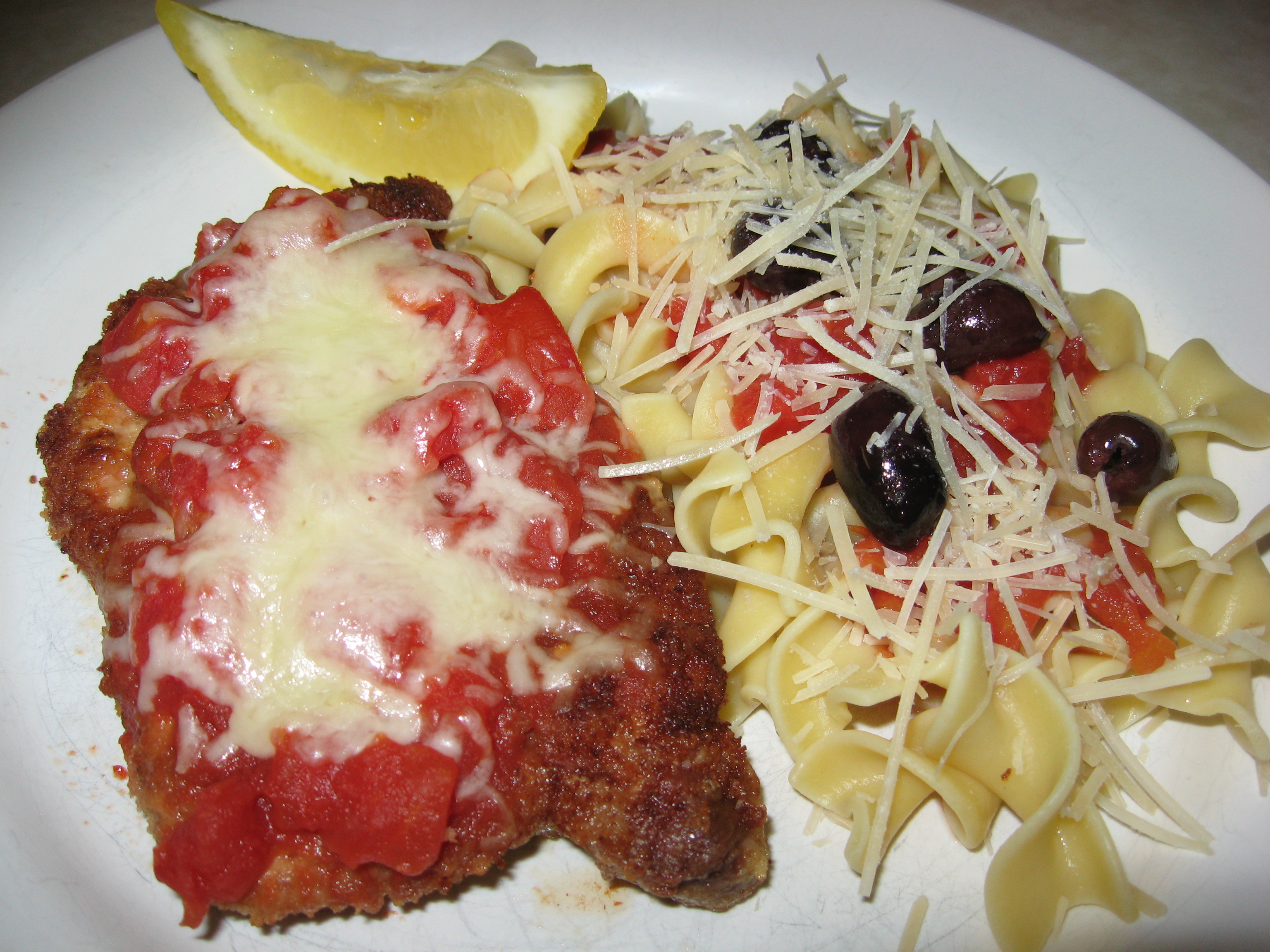
Pork Parmigiana

Standard

Pork Parmigiana in baking dish Pork Parmigiana plattedPork Parmigiana

Makes 4 servings


I haven’t made this dish in just ages and it was a very popular one served at home and in restaurants in the 50’s.  However, then it was made with veal which was so much more economically priced than it is presently.  So, pork once more it is and nice that it’s still so well priced.  My dish turned out delicious and I deem that you can serve it either for your family or guests. And by the way, I served this with noodles topped with diced tomatoes, Parmesan and black pitted olives and sided with a lovely romaine salad.


Ingredients:

  1. Four 1/4″ to 1/2” thick boneless pork chops—center cut about 1 ¼ to 1 ½ lb.
  2. 1/4 C. olive oil
  3. Flour which has been spiced liberally with S&P– for dredging
  4. Plain bread crumbs for dredging (which if you wish you can add in some shredded Parmesan)
  5. 2 eggs –beaten
  6. S&P to taste
  7. 1/2 C. vermouth or white wine
  8. Juice of 1 lemon
  9. Tomato sauce or chopped tomatoes- up to you how much you want to use
  10.  Sliced mozzarella or shredded Italian cheese mixture
  11. Minced fresh parsley leaves for garnish
  12. One lemon cut in quarters

Directions:

  1. Pre-heat the oven to 450.
  2. The chops should be about 1/4 inch thick; if they are not, and mine were 1/2 inch thick, do the following: Put the chops between 2 sheets of saran wrap or wax paper and roll them gently with a rolling pin till they are approximately the correct thickness.  This I actually think made them extra tender to eat so I would do this even if they are about 1/4 inch thick.  You can also pound them gently.
  3. Beside your burner, place one platter with the flour, the next one with the beaten eggs and the third (nearest the burner) with the bread crumbs.
  4. Heat the oil in a very large skillet over medium heat-you don’t want to crowd the chops.
  5. When the oil is hot (a pinch of flour will sizzle), dredge the chops, one at a time, in the flour and then the egg dip and then the bread crumbs, and place in the skillet to brown. Even though this is pork, undercook them a bit because they’ll continue cooking in the oven.  So, the browning process shouldn’t take more than 2 minutes per side. Cook the chops over high heat enough to make the oil bubble. As well at this point, have an oiled oven proof dish next to your burner.
  6. As soon as your chop is brown on one side (they brown fast so watch closely), then cook the other side. When the chops are done, place them in your oven proof dish without overlapping.
  7. Empty your skillet from the remaining oil and return it to the burner.  Add the wine/vermouth over medium-high heat and cook, stirring until the wine is just about evaporated.  Add the lemon juice and stir.
  8. Top each chop with the lemon/wine mixture (there won’t be much); then top with as much tomato sauce or diced tomatoes as you wish (usually it’s just a spoonful or two); and lastly top with either a thin slice of mozzarella or as much shredded Italian Cheese mixture as you wish.
  9. Place the baking dish in the oven until the cheese is melted—about 5 to 10 minutes.
  10. Serve immediately garnished with some chopped parsley on the top and a lemon wedge on the side.


For easy access and printing of this and past recipes, visit Margot’s blog http://blog.tempinnkeeper.com  Call Margot for personal cooking help or hosting

@ 721-3551.

Margot is a self-taught enthusiastic & passionate cook. Having been an inn-keeper for 5 years at her own inn, she accumulated a lot of good recipes which she loves to share.

Fennel Salad a la Siciliana

Standard

 Fennel Salad a la Siciliana

Serves 4


Ingredients:

  1.  3 or 4 Honey Tangerines or 3 blood or navel oranges
  2. 1/4 C. olive oil
  3. 1 Tblsp. red wine vinegar
  4. 1 Tblsp. or more of minced fennel tops
  5. Salt and Pepper
  6. 2 bunches trimmed arugula (I used the baby arugula)
  7. 2 medium fennel bulbs, cored, and halved and trimmed
  8. 1/4 C. oil cured black olives

Directions:

  1. I sectioned the tangerines and used them.  If you are using oranges, discard peel and all of the white pith; then slice crosswise into thin rounds and set aside.
  2. Mix together the olive oil, red wine vinegar and minced fennel tops.  You can either put this in the salad bowl along with the S&P before you put in the rest of the ingredients or you can mix it in a jar or pour it on after the salad is in the bowl.
  3. If you are using regular arugula, tear it into large pieces and arrange in the bowl. If you are using the baby arugula, just throw it into the bowl. Slice the fennel bulbs into long strips and place on top of the arugula.
  4. Toss the salad just before serving, adjust the seasoning, and then arrange the orange slices or tangerine sections on the top along with the black olives.


Mélange of Oven Baked Vegetable with Basil

Standard

melange of oven baked veggiesmelange of baked veggies 2 

Mélange of Oven Baked Vegetable with Fresh Basil

Serves 4-6 as a main dish or 8 as a side dish

This is a dish that is not only gloriously healthy but visibly gorgeous as well

For the baking, using this recipe as is, I use a 17 X 14 high sided octagonal aluminum turkey pan

Keep scrolling down for more additional recipes to be made from this main recipe

Fast, before it’s too late; the fresh veggies are at their prime now.  Farmers market or commercial markets, this is when you find them at their very best.  This dish is a bit time consuming but honestly, it’s worth the effort.  And best of all, it’s a glorious looking dish and it’s great for left-over’s.  Actually, it becomes tastier after having congealed a day or two.  If this dish doesn’t deplete fast enough for your desire, next week I will be offering two additional really tasty recipes that you can make from the left-over’s.

Ingredients:

  1. 10 garlic cloves
  2. 2 large onions thinly sliced or 4 smaller ones
  3. Zucchini-2 lbs.-I cut them long ways in quarters and then sliced them
  4. 2 large eggplant, about 2 lbs. total, sliced ½-inch thick and salted (you can leave the skin on and if you have time salt them liberally, put them in a colander and let them drain their liquid for 1/2 hour up to a couple of hours.  Then pat them dry.)
  5. A total of 4 assortment of red, yellow and orange bell peppers, stemmed, peeled if desired,( I didn’t peel them) seeded and sliced into 3-4 pieces each
  6. 4 or more if you think needed ripe red tomatoes—if you wish they can be cored, skins and seeds removed and cut into thick slices however I didn’t do that.
  7. 20 fresh basil leaves torn in half (or you can use 1 Tsp. fresh thyme, rosemary or savory leaves but I really like the basil).
  8. 1 C. flat leaf parsley-chopped fine
  9. 1 ½ Tsp. salt and some ground pepper to taste
  10. 1/2 C. to 1 C. of olive oil
  11. Extra fresh herbs and grated Parmesan for garnish

Directions:

  1. Preheat oven to 350.
  2. Peel garlic and cut in half. (Hints for easy pealing: Drop in boiling water; leave it there for 30 seconds, remove and peel. Or toast in dry skillet over medium heat, shaking frequently for 3-4 minutes.)
  3. In a casserole, make two layers of the following and it’s best to use the order listed below:
    1. Onion
    2. Eggplant
    3. Peppers
    4. Tomatoes
    5. Zucchini
    6. Parsley
    7. Basil or herbs
    8. Salt
    9. Pepper
    10. Garlic cloves
  4. Drizzle the Mélange with olive oil and place in the oven.
  5. Bake in a large pan that has high edges for about an hour, pressing down on the vegetables occasionally, until they are all completely tender.
  6. Garnish and serve hot or at room temp.

For easy access and printing of this and past recipes, visit Margot’s blog http://blog.tempinnkeeper.com  Call Margot for personal cooking help or hosting @ 721-3551

Margot is a self-taught enthusiastic & passionate cook. Having been an inn-keeper for 5 years at her own inn, she accumulated a lot of good recipes which she loves to shar

Mélange of Oven Baked Vegetable with Fresh Basil Additional Left-Over’s Recipes

So, here it is just as I had promised.  Enjoy!!!!

veggie potage

 Veggie Potage

  1. In a large saucepan, heat about enough chicken or if you prefer, a vegetable stock to combine with the amount of leftover veggies you have.
  2. Puree your veggies along with the stock with a processor or immersion blender.
  3. If  the mixture is too thick, thin it down a bit with more stock until it’s the consistency that you wish. If it’s too thin, add some crushed croutons.  You can also add some canned well rinsed white beans.
  4. Serve topped with Parmesan and more croutons or a float of sherry.
  5. Healthy, easy and perfect on a cold day.

Melange of Veggies Dip or Spread

(For very healthy, easy to grab snacking or for party appetizers to be served with crispy crackers or crusty French bread slices).

  1. Put your left-over casserole bits in a blender and blend it till it makes a nice spread.
  2. For appetizers, this is the way I like to serve it: On a thinly sliced toasted baguette I spread some room temp or even cold spread and top it with crumbled goat cheese and some water cress leaves.  It’s delicious.  However, you can also do the warm versions below.
  3.  You can do the work for your guests and place a dab of the spread on thinly sliced baguette slices, top them with Parmesan or some other cheese of your desire, place on a cookie sheet and carefully broil or bake at 450 till bubbly and perfect to serve.
  4. Or the easier, lazy way is the following:  you can heat the total amount of the spread topped with some cheese in an oven proof dish nice enough to serve your guests and place the bowl on a platter surrounded by crispy crackers or thin slices of crusty baguette and let the guests do their own serving.
  5. Or you can even use the left-over’s unblended but placed on top of some thawed frozen pastry to make a Provencal pizza.  For extra toppings you use some chopped pitted black olives, anchovy fillets and Parmesan.  Before putting the extra toppings bake the “ratatouille” on the rolled out and fork pricked pastry in a 400 degree oven for about 18 minutes; place on the extra toppings and bake an additional 4-5 more minutes.  Slide on a cutting board sprinkle with a bit more cut basil, cut into squares and serve.

For easy access and printing of this and past recipes, visit Margot’s blog http://blog.tempinnkeeper.com  Call Margot for personal cooking help or hosting

 @ 721-3551.

Margot is a self-taught enthusiastic & passionate cook. Having been an inn-keeper for 5 years at her own inn, she accumulated a lot of good recipes which she loves to share.
 

Mini Macaroni and Cheese alla Italiana

Standard

Mini Macaroni and Cheese alla Italiana

Makes 6 Ramekins (4 ½ inch variety)


I heard this recipe on NPR—it’s that of the beautiful Nigella Lawson-and I thought that it would go beautifully as part of one of my catered dinners. So, thanks go to NPR and Nigella. Everyone loved this dish as I also did.  And I think you also will. It’s a delicious twist on our ole’ Mac & Cheese.


Ingredients:

  1. Butter spray for the ramekins
  2. 1 C. grated Gruyere
  3. 1 Tblsp. cornstarch
  4. 4 oz. fresh mozzarella (not buffalo) chopped
  5. 8 ounces pennette, or chifferi or elbow macaroni (I found some small pasta made by De Cecco—but Barillo also makes some)
  6. Salt for the pasta water
  7. 1/4 C. white vermouth or wine
  8. 1 ¼ C. chicken broth
  9. 1/4 C. mascarpone

10. 1 Tsp. truffle butter/paste or a few drops truffle oil (very expensive so actually I ground up some fresh mushrooms and along with a dash of Worcestershire sauce, mixed these ingredients with some soft butter and used that. It seemed to work).

11. 3 Tblsp. grated Parmesan

12. Ground white pepper or black is OK too

Directions:

  1. Preheat the oven to 400 degrees.
  2. Spray butter the ramekins.
  3. Toss the grated Gruyere with the cornstarch in a bowl.
  4. Boil the pasta according to the package directions, however, cut the cooking time by several minutes—so that the pasta is very al dente but still eatable. I watched it very carefully. Drain it and keep it in your colander for later.
  5. In a very large pan that will eventually hold the pasta in it, heat the vermouth to a boil and then add the chicken broth.  Let it come to a boil again and take it off the burner and whisk in the cornstarch-tossed Gruyere.  This mixture will melt into a mass of gooey cheese strings.  Add the Mascarpone and whisk again. Then add the truffle oil/butter stirring it in the sauce. Lastly add the pasta and the chopped mozzarella.  Stir once again to make sure everything is well mixed.
  6. Ladle the cheesy pasta into the sprayed ramekins trying to get an even amount of pasta and sauce in each. (The sauce will seem very liquid but don’t worry; the pasta will suck it up in the oven. Sprinkle the Parmesan on the top and then with pepper.
  7. Bake for 10 minutes in the hot oven.  Let stand 5 minutes before eating.  (I filled the ramekins with the pasta, etc. but left most of the liquid out because I was not going to serve them right away. I saved the liquid in a separate container. Several hours later, when I was ready to bake the ramekins, I put in my saved liquid in each ramekin and then baked them.  They turned out just fine.)
  8. Lastly, Nigella says that you can broil these ramekins as well but I thought that baking them would be better.

Ginger Carrot Soup

Standard

Ginger Carrot Soup

Serves 4


“And a bigger thanks for last night—we’re still talking about how great the food was this morning. Our kids LOVED the soup….”  This lovely compliment about a Valentine catered dinner I did was about this soup.  I must agree, it really is good. 


Ingredients:

  1. 2 Tblsp. olive oil
  2. 1 3-inch piece of fresh ginger, peeled and coarsely chopped (about 1/4 C.)
  3. 1 small yellow onion, coarsely chopped (about 3/4 C.)
  4. 4 C. mini peeled carrots –about 1 ¼ lbs. (you can find these in a package at your grocery store)
  5. 5 C. vegetable broth
  6. 1/2 C. fresh orange juice
  7. Pinch of ground nutmeg
  8. S&P to taste
  9. Crème Fraiche or sour cream for garnish

Directions:

  1. Heat oil in a large saucepan over medium heat.
  2. Add ginger and onion and cook, stirring occasionally, until soft and fragrant (about 5 minutes).
  3. Add carrots, stock and juice. Raise the heat to medium-high and bring to a boil.  Reduce heat to low, cover and simmer until carrots are very tender (about 45 minutes).
  4. Puree the soup in the saucepan using an immersion blender. Or if you don’t have one of those wonderful implements, let the soup cool and puree in a blender or food processor and return to the saucepan. The soup will be quite thick in texture and if you would look a smoother soup, pass the mixture through a sieve.  I left it thick and everyone loved it that way.
  5. Add nutmeg, S&P to taste.
  6. If the soup still looks too thick for your taste, you can thin it with a bit of water or vegetable stock.
  7. This soup can be served chilled (refrigerate for at least 6 hours and up to 5 days), or at room temp or hot.  I reheated mine because my clients wanted it hot.
  8. Garnish with a spoonful of crème fraiche or sour cream.  And I put one sprig (standing straight up) of green onion top in mine.

Roasted King Salmon with Cashews and Apricot Couscous Along with a Spicy Yogurt Sauce

Standard

IMG_3241

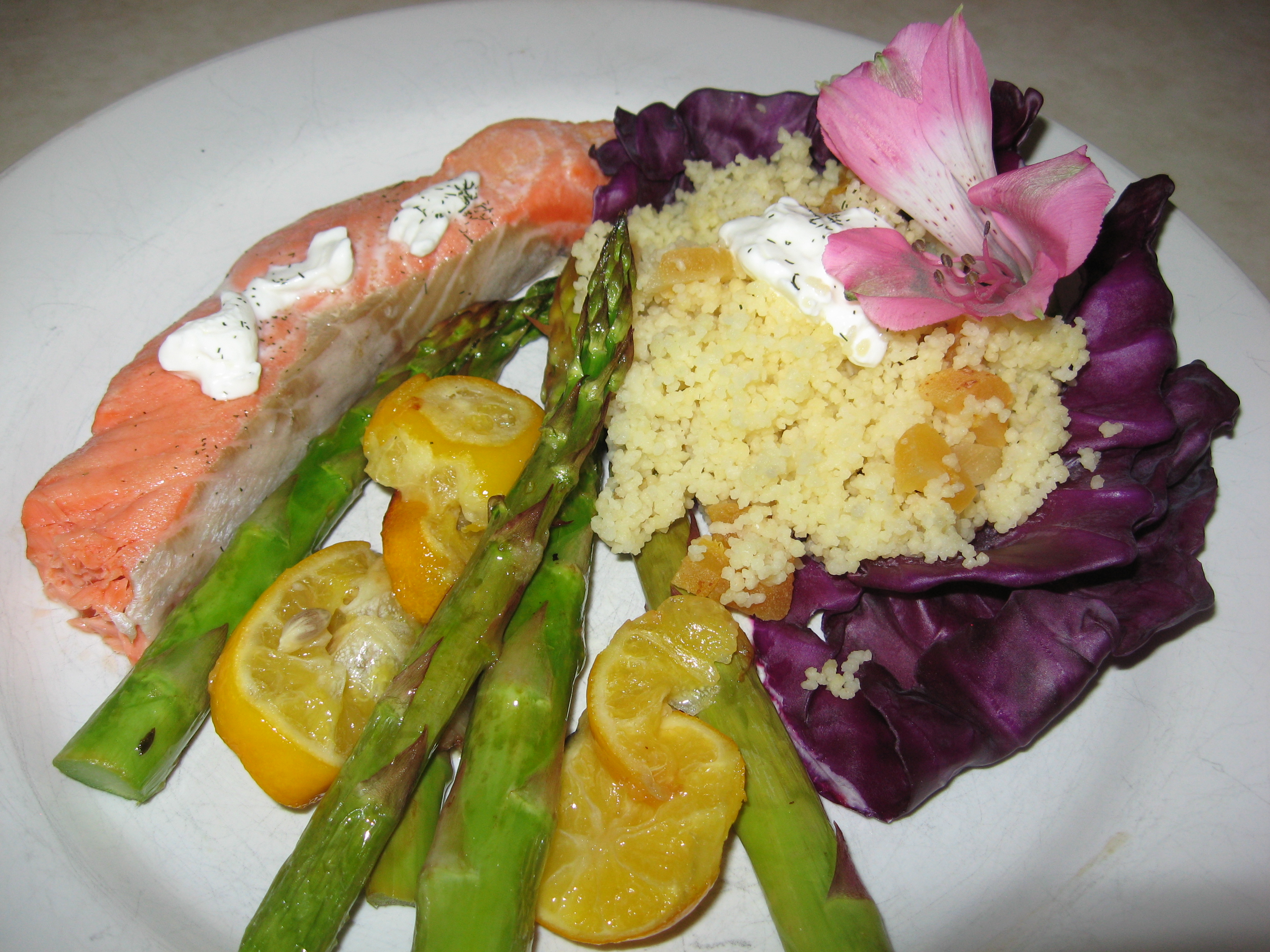
Roasted King Salmon with Cashews and Apricot Couscous Along with a Spicy Yogurt Sauce

4 servings

This makes a lovely fairly easy dinner or lunch to serve for guests. I decided to make my couscous plain because of the accompanying sauce however below is one other idea for a another couscous that would also go well with this salmon and sauce. Vegetable wise, I served it with the Lemon Lovers Asparagus and as you can see, this whole assemblage made for a very appetizing serving.

Ingredients for the salmon:

  1. 1 ½  lb. Pacific King Salmon-cut into 4 pieces
  2. 1/4 C. Toasted Chopped Cashews

Directions for the salmon:

  1. Toast the cashews in a dry pan till fragrant and lightly browned.(2-4 minutes).
  2. Place salmon in an olive oil sprayed pan and spray the salmon generously with olive oil.
  3. Place in a 350 degree pre-heated oven and bake for about 25 minutes until just cooked through and it flakes just a bit.  DON’T OVERCOOK IT—it’ll continue to cook when you remove it, so better underdone than overdone oven wise.  Watch it carefully.
  4. Sprinkle the cashews over the salmon just before serving.

Ingredients for the Apricot Couscous #1 (see below for another recipe):

  1. 1/2 C. up to 2/3 C. chopped small dry apricots soaked in 2/3 C. hot water till soft and then drained
  2.  1 C. dried couscous
  3. 1 ¼ C. water
  4. 1 Tblsp. or more of sweet butter

Directions:

  1. Add water to pan and bring to a boil. Take off burner, add couscous and butter and cover.  Let sit for 5 minutes (till couscous is done) and then gently fold in the apricots.
  2. 2.    Please see below for another couscous recipe giving you another choice.

Ingredients for the Spicy Yogurt Sauce which is sort of like an Indian Raita:

  1. 1/2 C. plain yogurt (can be non-fat)
  2. 1/2 C. sour cream
  3. 1/4 C. scallions, minced
  4. 1/4 C. minced cilantro leaves
  5. 1 Tsp. minced fresh ginger
  6. 1 Tsp. ground cumin
  7. 1/4 C. finely chopped cucumber
  8. Cayenne to taste (optional—I didn’t do this for the salmon)

Instructions:

  1. Mix all of your ingredients in a small bowl and be sure to use this sauce within the same day that you want to serve it since it doesn’t keep that well.

Couscous recipe #2

Ingredients for couscous with apricots, ginger and scallion whites:

  1. 1 C. couscous
  2. 1 Tblsp. olive oil
  3. 1/2 C. chopped fine apricots
  4. 1 Tblsp. minced fresh ginger
  5. 3 scallions—whites only sliced fine
  6. 1 ¼ C. water

Instructions:

  1. Heat oil in a large saucepan over medium heat.  Add apricots, ginger, scallion whites and 1/4 Tsp. salt.
  2. Cook stirring until softened, about 2 minutes.
  3. Remove from heat and stir in couscous and cover.
  4. Let stand until the liquid is absorbed, about 5 minutes.
  5. Fluff with a fork.

Roasted Turkey Breast and that little blue button

Standard

IMG_3182 IMG_3184 IMG_3191

Roasted Turkey Breast and that little blue button

Probably 3- 4 servings for a 3 pounder

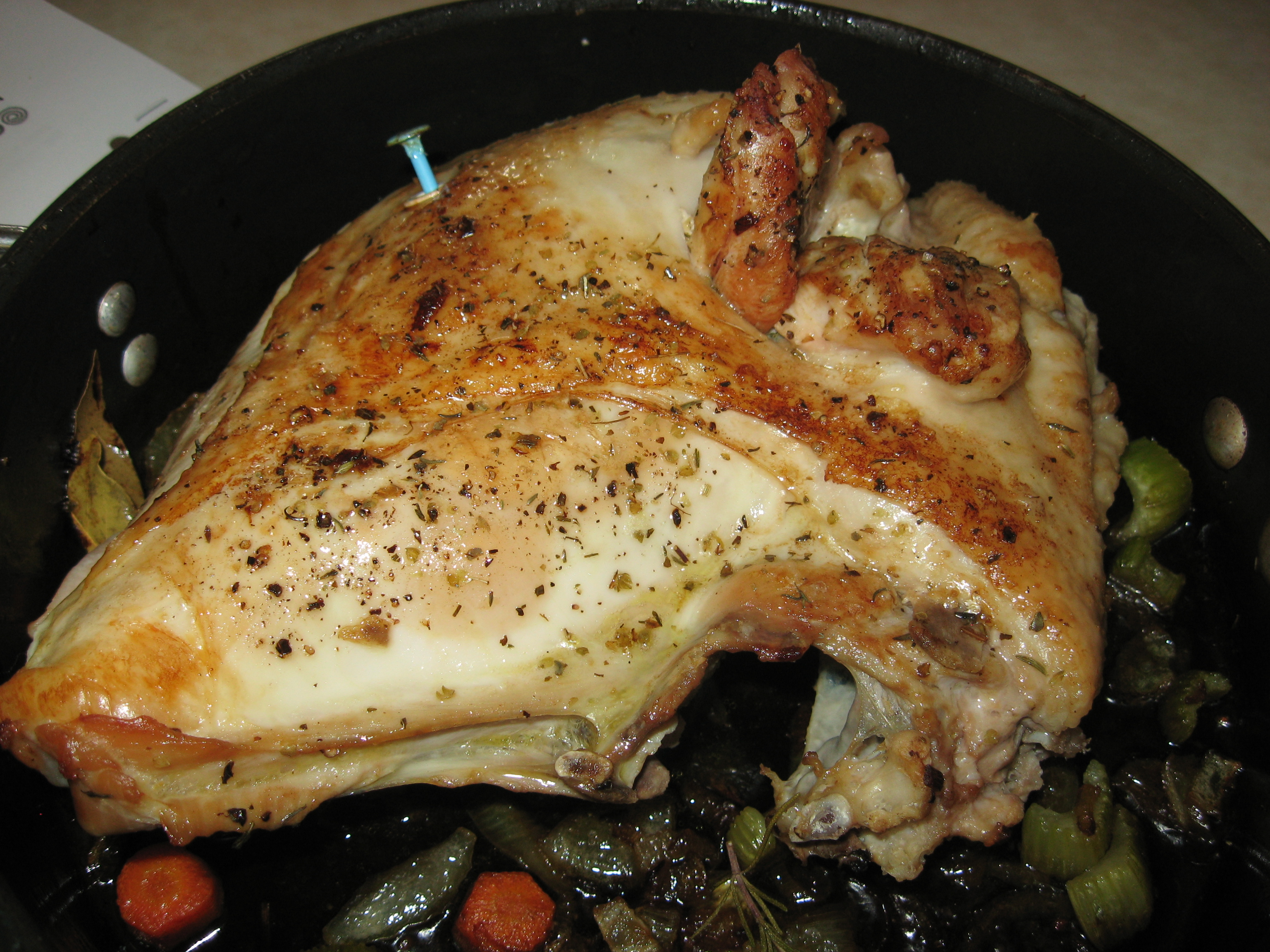
I really wanted to cook a pot roast, but oh my goodness, the prices of pot roasts were unbelievable.  What happened to a good price for a supposedly lesser cut of beef?  So I ended up buying a 3 lb. turkey breast with a bone.  It was well priced.  Turkey breasts can be so dry sometimes so I thought that I would experiment and try to cook it in a way to increase the moistness.  Indeed, the way I cooked it worked however, that little blue button that was inserted—supposedly to tell you when it’s done—no way.  So, beware because it’s not always correct.

Ingredients:

  1. One 3 to 5 lb. turkey breast, bone in
  2. 2- 3 Tblsp. butter or olive oil (I used butter)
  3. S&P to taste
  4. Italian seasoning
  5. Bay Leaf
  6. One small sprig of fresh rosemary
  7. 1 large chopped carrot
  8. 2-3 stalks of celery, chopped
  9. 1/2 to 1 onion chopped

Directions:

  1. Preheat oven to 325.
  2. Wash the breast, wipe it dry and season it with S&P and some Italian Seasoning.
  3. In a large oven proof skillet, melt the butter or heat the olive oil over medium high heat.
  4. Add the vegetables and sauté them for about 5 minutes—till they are glistening but not browned. Remove and set them aside.
  5. In the same skillet, over medium heat, brown the turkey breast that you have seasoned with S&P and Italian seasoning. Brown each side for about 4 minutes per side.
  6. Set aside the breast and place the veggies back in the skillet.  Then place the breast over them.  Add the bay leaf and rosemary sprig.
  7. At this point, I sprayed some olive oil cooking spray over the breast.  Place the skillet in the oven.
  8. I figured that it would take 1 ½ hour to cook (30 min. per lb.).  Every 15 minutes or so, I would baste the breast with the drippings and at the 1 hour point, the blue button popped out.  So, of course, I cut into the breast and no way, Jose—it was not done.  It did take another half-hour.  But all in all, this was an easy way to cook a turkey breast and it turned out super moist and tender.

Oh Hale to the Ole’ Pot Roast- 7 Different Ways

Standard

511px-BeefCutChuck.svgOh Hale to the Ole’ Pot Roast- 7 Different Ways


The poor relative of a better cut of meat, the pot roast was always considered a non guest dish.  I want to disagree with this image because truly, a good pot roast is not only an art to make but also a delicious dish to serve—for your family and guests. A good pot roast takes a bit more effort to make because the meat is not from the more elegant cut of the animal. However, this is what can make a pot roast more delectable because of the special seasonings used, the sometimes tender and time staking marinating and the always cautious cooking that it takes. The main trick of presenting a superior pot roast is to not overcook it, make sure about the heat used and to be able to spend quality time checking in on it.  Here are several recipes I have always enjoyed in regards to the potting of the roast.  PS—in regards to making your gravy, remember to thicken the liquid at the end of cooking by either using corn starch mixed with water (2 Tbsp. to 1/4 C. cold water for about 2 C. cooking liquid) and then whisk it slowly into the hot liquid; or if you don’t want to use corn starch, in a different skillet, melt some butter and then add some flour—whisk it till smooth and then stir in some of your hot liquid, a bit at a time. ( For the flour method the approximate correct measurements to use are the following: 1 ½ Tblsp. butter, 1 ½ Tblsp. flour to 1 to 1 ½ C. liquid.)

  1. 1.    The Basic Pot Roast

Ingredients:

  1. 1 (3-4 lb.) piece of chuck or rump roast (tied if necessary)
  2. 2 bay leaves
  3. 1 or 2 garlic clove—peeled and chopped fine or slivered
  4. Sea Salt and Ground Pepper
  5. 2 or more Tblsp. unsalted butter
  6. 2 Tblsp. olive oil
  7. 3 Tblsp. chopped raw bacon in small pieces
  8. 3/4 to 1 chopped onion—rough chop
  9. 2 large peeled and chopped carrots in small slices
  10. 3 celery stalks chopped in small slices
  11. 1/2 C. chopped parsley-add at the end
  12. 2-3 Tblsp. flour to add to the veggies at end
  13. 1/2 C. wine
  14. 1 to 2 C. chicken, beef or vegetable stock-I like a good beef stock
  15. 3/4 Tsp. of your favorite dry blend of spices
  16. Optional: 3/4 warm sour cream

 Directions:

  1. Salt and pepper the roast and insert 1/2 of the garlic slivers as well as 3/4 of the bacon into several slits that you have made in the roast. ( For a different kind of roast, rub the meat with 1 Tblsp. of mild chili powder- if you like hot use cayenne.)
  2. Heat the oil and butter over medium-high heat in a Dutch oven or other heavy pot that can be later lidded; brown the roast on all sides—take your time to do this and make sure the heat is not high.  You do not want the fat to burn.
  3. Remove the meat to a side platter and in the oil/butter, still over medium high heat, brown the vegetables-stirring frequently. Stir them until softened and somewhat (not too much) browned—about 10 minutes. Add the parsley towards the end. Before adding the stock, add 2 to 3 Tblsp. flour to the vegetables and stir it till you can’t see any white of the flour left.
  4. Add about half the stock (and warm sour cream if you wish) and the red wine, your blended spices and return the roast to the pot, and turn the heat to very low however the liquid should be simmering at all times. (Save the other half of the stock to use if you find the stock disappearing).  There should be at least 1/2 inch of liquid in the pot at all times.
  5. Here’s where you need to spend time with this recipe. Every 15 minutes or so, turn the meat—and cook it until it is fork tender which means that your fork will pierce the meat without pushing too hard and the juices will run clear—about 1 ½ to 2 ½ hours—but it may be longer if the roast is higher than it is long.  A very thick roast can take as long as (sigh) 4 hours. (You can also bake a roast, covered, in a slow oven—300- 325 degrees—but you need to turn and look at it every 15 minutes just as if you cook it on top of your range. I prefer to do it stove top)
  6. If for some reason your roast seems to be dry (oh no) your heat has been probably too high.  DO NOT OVER COOK THE ROAST. Believe me, when the meat is tender, it is done and remember, even when you remove it from the heat—it still will cook for 15 minutes or so.
  7. The Final Step: Remove the meat to a beautiful platter and keep it warm with some aluminum foil.  Skim the fat (if any) from the juices in the pot and turn the heat to high.  Cook, stirring and scraping the bottom of the pan until the liquid is thick and almost evaporated.  Adjust for seasonings.
  8. Serving: slice your meat and serve the juices on the side.  Or if you wish, pour the juices over the meat.
  1. 2.    Pot Roast with Tomatoes

Prepare and cook meat as above except:

  1. For the liquid, use 1 C. stock and 1 C. canned tomatoes. There should be about 1/2 inch of liquid in your pot.
  1. 3.    Pot Roast with a Sour and Sweet Gravy
    1.  When the roast has been set aside, in your stock, you can add 1 tsp. of sugar and 1 ½ Tblsp. lemon juice or vinegar.


  2. 4.    Pot Roast with Cider
    1.  Soak your meat for 12 hours in this marinade and also use this marinade in the stead of the liquids mentioned above and cook as in the basic recipe:

Cider Marinade Ingredients:

  1. 2 C. cider
  2. 2 small sliced onions
  3. 1/4 Tsp. ginger
  4. 3 cloves
  5. 1/4 Tsp. cinnamon
  6. 2 Tblsp. sugar
  1. 5.    Spiced Pot Roast

Spiced Beef Marinade ingredients:

  1. Cider vinegar or dry wine
  2. 2 sliced onions
  3. 1/2 Bay leaf
  4. 1 Tsp. Cinnamon
  5. 1 Tsp. allspice
  6. 1 tsp. cloves
  7. 1 ½ Tsp. salt
  8. 1 Tsp. pepper

Vegetables to use for the last 1/2 hour of cooking

  1. 2 onions
  2. 4 large carrots
  3. 1 medium large turnip
  4. 1 stalk celery
  5. Marinade the roast in the above marinade for 12 hours or more.
  6. Take the meat out and place it in a roasting pan. (Save the marinade)
  7. Heat the following to a boiling point and pour it over the roast which you’ve placed in a pot that has a lid: 1/2 of the marinade and 2 C. water.
  8. Cover the pot and roast it in a slow over, 275 degrees, for 3 hours.
  9. Process the vegetables to a small grind and sauté in butter till golden brown. Add these ingredients to the roast for the last 1/2 hour of cooking.
  10. The sauce can be thickened with flour or corn starch.
  1. 6.    Pot Roast with Cranberries

Follow rule for basic pot roast and substitute for the liquid water and after 1 hour of cooking, add 2 C. of raw cranberries and additional boiling water if needed.

  1. 7.    Sauerbraten

Ingredients:

  1. 3 lbs. roast
  2. Bacon which you have larded in the meat
  3. Pepper rubbed on meat
  4. Garlic inserted in slits made in meat
  5. Equal parts mild vinegar or white wine and water
  6. 1/2 C. sliced onion
  7. 2 bay leaves
  8. 1 Tsp. pepper corns
  9. 1/4 C. sugar
  10. For the very end, 1 C. sour cream or sweet cream

Directions:

  1. Place prepared meat in a crock like pot
  2. Heat but DO NOT BOIL the ingredients e through i and while hot, pour over the meat.
  3. Place in refrigerator for at least 3 days but preferably 7 to 10 days.

Turn the meat once a day.

  1. When the meat is well marinated, take it out and place it in a pot.
  2. Use the vinegar mixture in place of the stock.
  3. Cook as in the basic recipe and when the meat is tender, remove it from the pot.
  4. Thicken the gravy with flour and add 1 C. sweet cream or sour cream

Any of these recipes are delicious served with potato dumplings, noodles and a hearty red wine.

Bon Appetit